
Relative Fiction
thoughts on Julien Baker, Raymond Carver, and my Scorpio Moon

As we burst into spring, I’m sharing some long simmering thoughts about two winter favorites of mine. Content warning for references to fictional scenes of domestic violence and suicidal ideation.
The winter of ‘22 I had a Julien Baker phase.
I listened to her third record Little Oblivions incessantly. It was dark that winter and everyone was dodging Omicron. I spent it holed up at my parents’ house, reading Ocean Vuong and listening to Little Oblivions over and over again.
I like to blame my love for Julien Baker on my Scorpio moon. If you don’t follow astrology – and I’m more a tarot queer than a zodiac one – this means my inner self and emotions (my moon) take on traits of Scorpio: intuitive, reserved, intense. “A bit dramatic,” says my Co-Star. Which, yes – that’s me! I appreciate a bleak story or an intense film. Things like Brandon Taylor’s Real Life, and the maritime pathos of Moby Dick, on one hand. (A film I’ve been wanting to watch for a while is Melancholia. It just looks so SAD!) On the other, I also enjoy something like The Bear’s more anxiety-inducing episodes or the howling fury of Ezra Furman’s album Twelve Nudes. A few things hit both ends at once, miraculously – Twin Peaks, definitely, and parts of Neon Genesis Evangelion. A part of me enjoys the pure nervous system shock of these works (I am also a Gemini sun), but I think there’s something about their drama and weight that hails my lunar Scorpio moodiness.
Every winter since I listen through Little Oblivions at least once. The people in Baker’s songs are filled with aches and pains, and the images feel painfully real, even when they’re poetic. In one song, the singer claws at her lover’s arms, scratching the skin like a lottery ticket. In another, a friend’s hands gently lift a moth from a car grille. The song “Relative Fiction” opens with a long gaze over the edge of a building, the narrator’s eyes tracing the fall of glowing embers to the street below.
This winter, just about when I began my yearly Little Oblivions listens, I was also slowly making my way through Raymond Carver’s last collection Where I’m Calling From. Carver was an American writer most active in the 80s. Many of his tales take place in the Pacific Northwest, where he grew up. Visiting Portland in February, I rode down the highway and the humbling sight of Mount Hood rose up on the horizon. I live sheltered under New York’s skyscrapers. Facing nature’s grandeur, I shuddered.
Carver gives me a similar feeling: his portraits of life in that region are like sharp perspectival shifts, beautiful closeups of tough and mean people. His stories are stark and matter-of-fact. They are short and brutal – but not nasty. Just honest. A kid brings home his catch from an afternoon fishing to find his parents arguing. A couple takes perverse advantage of a house-sitting gig. A mother drives out of her way to attend a funeral service for a girl she feels responsible for, disgusted by her husband’s apathy.
These people are not famous or royal: they are people getting by day to day, paycheck to paycheck, eking out their living in places neoliberal capitalism left for dead. Many of them deal with fucked up situations – spouses cheat on each other, men ogle women, children get hurt or worse. Carver doesn’t absolve them of their hand in the matter. Or if they aren’t to blame, Carver never lets us forget the human causes. Nobody is winning.
In both Carver’s and Baker's writing, everything feels clear. Material. They rarely use ten-dollar words. Phrases are short and declarative. The minimalism feels heavy, unbearable even; I find myself almost wishing for more sentences as cushion. Instead, the words go quick and hard, like whole icebergs compressed into icicles. Images like a car accident or a motel gazebo acquire weight through the heft of emotions stuck, unuttered, behind clenched teeth. In “Heatwave,” my favorite song of Little Oblivions, Baker passes a blazing wreck on the freeway, thinks of the life that’ll be compressed into an obituary, thinks, This is gonna make me late for work. And in the story “The Third Thing That Killed My Father Off,” the sight of a placid backlot lake turns sinister over the course of the story, as the reader learns more about the fish beneath the surface, swimming in great schools and eating decaying things.
Carver’s most famous story is “What We Talk About When We Talk About Love.” Four friends sit around a kitchen table, talking about, well, love. They pass around a bottle of gin and a bottle of tonic water. One mentions an old lover with brutal affections: “He dragged me around the room by my ankles.” They think about the fading of love after a partner has passed. “All this, all of this love we’re talking about, it would just be a memory.” They talk, drink, and the light in the room waxes, wanes.
I think of Edward Hopper’s Rooms By The Sea as the perfect example of that light in the room. This painting lodged in my head around the same time Little Oblivions came out – listening to the songs, I would think of this image, of light emanating into a room. It reminded me of the the dense, orange light I saw filtering through the doorway of the classroom I was working in at that time. There’s no prime “focus” of the painting: it’s mostly wall, with slivers of furniture and ocean. The light feels solid, as if it were intruding into the room and pushing the shadows away.
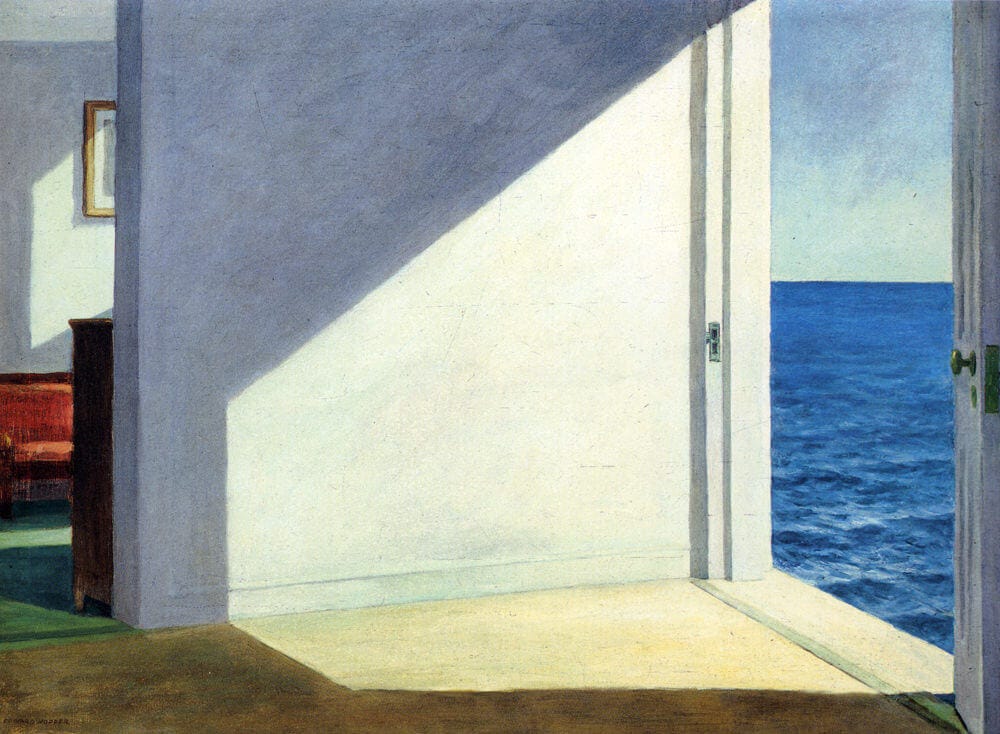
It’s easy to describe Little Oblivions and Raymond Carver stories as sad and dark. And like, they are – in ways both literal and deliciously metaphorical. In one of Carver’s crueler stories (“Little Things,” a cousin-tale of the Judgement of Solomon), the ebbing light of the street outside matches the dark inside. And in the entrance track, Baker asks, What if it isn’t black or white? What if it’s all black baby, all the time? I love this lyric. It seemed to clarify something for me. What the question leads to, for me, is the ever present sense of ambiguity, that there are no easy answers to anything.
In her devastating “Song in E,” Baker begs for violence, for the easy escape it would give her from taking accountability – I’d say, “Give me no sympathy.” It’s the mercy I can’t take. One character in “What We Talk About When We Talk About Love,” is a cardiologist: “I’m a heart surgeon, sure, but I’m just a mechanic. I go in and I fuck around and I fix things.” The story ends when the light fades.
The writer Eula Biss recalled that, after her uterine surgery, the nurse said there had been “a lot of hands” inside of her: “the technology that had saved me was simply hands.” Human hands groping in the dark. If it’s all black, all the time, then we better get better at seeing the dark for what it is.