
changing the light
a love letter to Middlemarch

It was inevitable: Middlemarch had a brat moment. The phrase in question was, “Even sympathy might make a wound.” I was on the subway when I read it. I closed the Books app, shook my head a little, and with a kind of gleeful grin I put on my headphones and queued up “sympathy is a knife.” 19th century girls were just like me fr !!!
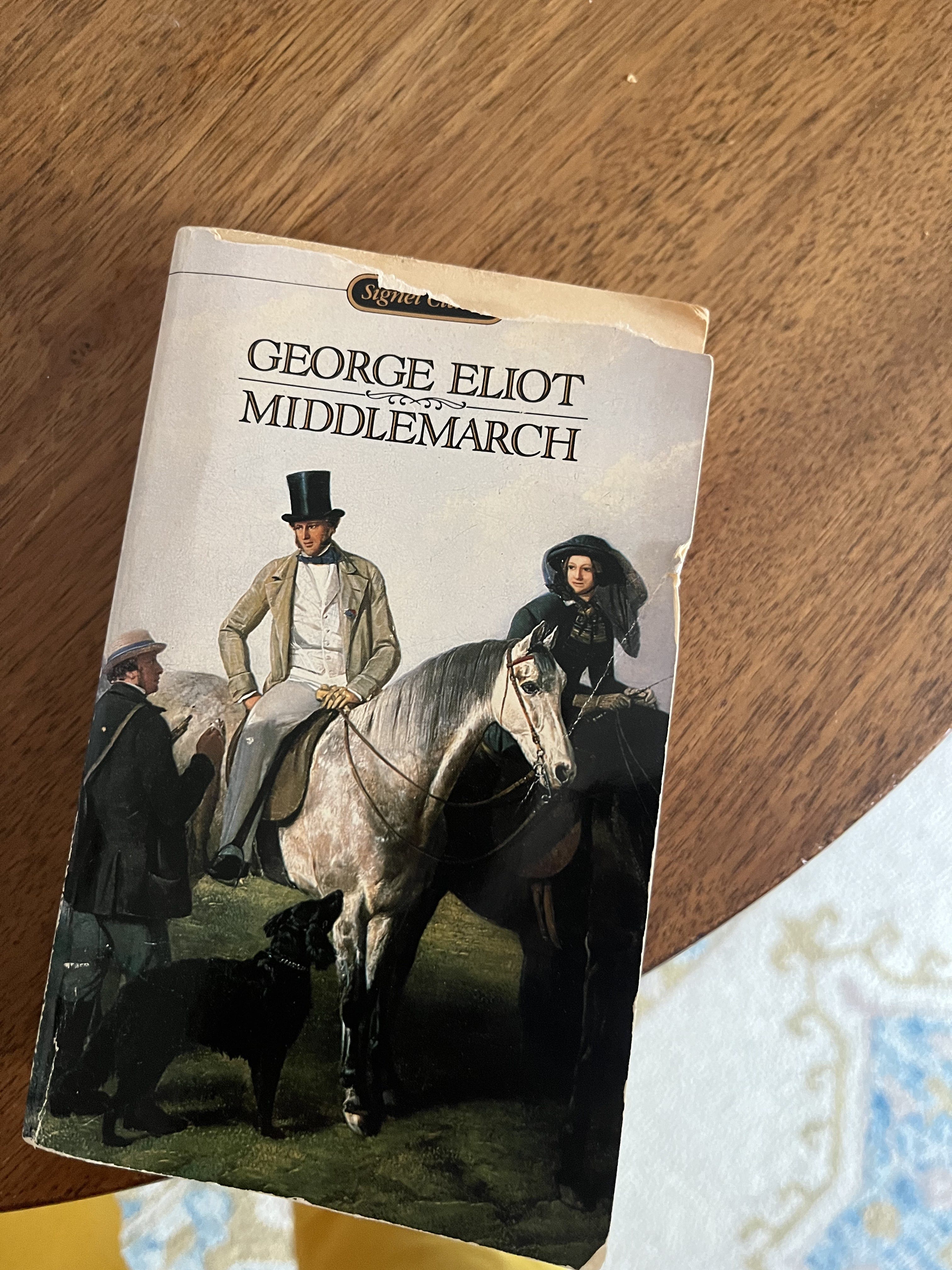
I love when a classic novel resonates with the present-day, and Middlemarch is full of such echoes. Over the past year, I read it for the second time. God I love it. Its drama, its gossip, its tender heart. I would often look up from reading and ask my partner or my friend, “Ugh! Can I tell you the latest in Middlemarch?”
Subtitled “A Study of Provincial Life,” Middlemarch takes you into the social life of a small town. It’s England in the 1830s, when developments in science and medicine accompanied stirrings of globalization and reform. Like today, so many aspects of the social fabric were transforming, and a lot of Middlemarch’s images feel familiar: neighbors side-eyeing land developments, politicians running questionable campaigns, hesitations or buy-ins around new technology. And workers continue to farm and townies continue to gossip.
The author, George Eliot – a deeply intellectual woman born Mary Ann Evans with a very complicated personal life1, who wrote under a male name – wrote Middlemarch in the late 1860s, recalling an earlier historical period. Eliot’s days were speeding up, and she envied past historians who had more time. “Time, like money,” she writes, “is measured by our needs,” and the needs of Eliot’s rapidly industrializing society were filling up the clock. Middlemarch was her study of the moment the gas just started to kick in.
There is no main character of Middlemarch – there are multiple plots, like a song cycle or an intertwined story collection (cf. Euphoria). The closest to a central figure is Dorothea, a woman with big philanthropic ideas and little practical experience. We start with her untimely marriage to an elderly scholar named Causabon. Her friend Mary – smart and steady – nurses a lifelong chemistry with the flaky village bachelor, Fred, despite their class and career divide. (It becomes a deliciously slow burn, a love triangle. I swear Chapter 66 gives Challengers.) Meanwhile, Fred’s sister Rosamond (~ the mayor’s daughter ~) makes eyes at Lydgate: the new doctor in town, ambitious for medical reform. And meanwhile, meanwhile! Causabon’s artsy young relative Will makes an impression on Dorothea, and Lydgate asks for medical funding from the disagreeable Mr. Bulstrode, Fred and Rosamond’s zealot uncle, and the kindly local vicar also has a crush on Mary (there’s the triangle!), and, and–
So there’s a lot happening in Middlemarch!
I first read Middlemarch six years ago, pre-lockdown. It’s wonderful to return and notice so much more – like walking past a garden plot after winter and seeing it blooming. I was struck by my attention this time to what I had ranked as subplots previously. My perspective had changed based on where I am on life’s trajectory. Before, I was so attuned to Dorothea’s arc. Her hopes, her idealism. I was just out of college, with so many of my life’s circumstances left unquestioned. This time, when I read about Lydgate facing financial woes, I read with tight attention, a familiar tension. When Fred wrestled with career choice, I recalled my own decision to transition, my own shifts in purpose. I was reading a painstakingly true account of young adults just figuring how to live, just as I am. In her introduction to my edition, Rebecca Mead points out how Eliot wrote to advance readers’ maturation. Middlemarch gives “the sense that we are being read by it– that we are being moved to new understandings of ourselves, and of those people around us.” I felt like Middlemarch traced the motion of my thoughts, their forms and colors.
Large portions of Middlemarch speak to a maturity in process. “Eliot saw her task as an ‘extension of sympathies’ that would make her readers into better people,” writes Paul Delany on Eliot’s project with Middlemarch, and Virginia Woolf famously called Middlemarch “one of the few English novels written for grown-up people.” I understand Woolf’s sentiment in the sheer comprehension of Middlemarch in covering the many interactions between people: matrimony, civics, duty, debt, vocation, legacy. There are characters grappling with these situations who are very young – Dorothea is 19 (!) when she marries Casaubon – and there are characters on their deathbeds who are still facing uncertainty.
In addition to her careful character renderings, Eliot throws in truisms like proverbs. “What we call our despair is often only the painful eagerness of unfed hope.” “The defiance was more exciting than the confidence, but it was less sure.” “Each crisis seems final, simply because it is new.” That these all ring true over a century and a half later tells me so much about the continuity of people.” To paraphrase her own words, they’re mines of truth, likely to outlast our coal.
Oh! How many times did I think of Middlemarch in any given week? How many times did I rant about it to my friends? I was so glad my therapist had read Middlemarch, because I would start any given session saying, “Okay, so this chapter in Middlemarch has me feeling this way…” And I was glad that we were both Casaubon haters. And yet, even Casaubon is given his sympathetic due! He’s just a scholar who wants to make a mark on the world! No Middlemarcher escapes brutal empathic mercy2. No one is protected either – Eliot’s stance on Dorothea’s naive idealism feels reverent as well as ironic. The irony fades out as the novel progresses, a development which, to cite a remark in the afterword of my other edition illustrates how, “There is no longer a need for small ironies; Dorothea is up against things as they are3.” I think Middlemarch channels the friction, the chemistry, the ache of being alive in this complicated-ass world.
And Eliot was a complicated-ass person – very much a problematic fave. In the course of writing this, I found this review by Paul Delany of an Eliot biography, and learned some insights into Eliot I hadn’t known before. She had a rough upbringing; her mother passed when she was 16 and she had very little prospects. In living with G.H. Lewes, who was married to another woman, she was socially ostracized. She wrote an essay calling Zionist Jewish people “the best of their race,” a fucked-up belief then and now. Delany comments on her politics as such: “She puts her faith in a friendly identity politics: let there be separation, but with mutual respect and kindness. How has that been working out?” [Emphasis mine.]
Middlemarch is beloved by a range of people, from one of my favorite lesbian book critics to a friend’s conservative parent, I think because Eliot takes such a very middle of the road stance. When a villager takes a shot at Ladislaw’s “queer genealogy” as a Polish man – the phrase itself an efficient gloss of racism and otherness – it’s waved away by Eliot with the same energy of an elderly relative’s racism being excused. In reading Middlemarch and canonical works in general, I want to figure out how to tug it from these middle positions towards more radical edges. In doing so now, I also think it’s important to know who we’re working with. Death-ish of the Author.
In a pivotal conversation, Will characterizes the “poetic condition” as a state like “a hand playing with finely ordered variety on the chords of emotion… [when] knowledge passes instantaneously into feeling, and feeling flashes back as a new organ of knowledge.” This transformative flash animates all of Middlemarch. It sheds light on a “particular web” of human relations, following characters with a microscopic focus and expanding their thoughts to almost excessive effect.
Illumination, words, and knowledge braid together in a way that feels classical in the Platonic sense or even in the “Let there be light” Christianity sense. Eliot compares presumptuous “egoism,” when every event seems to revolve around you, to the way a candle light refracts on buffed metal. Lydgate’s treasured medical advances resembles streetlights switching from oil to gas, “showing the very grain of things.” And on a fateful night, Mary squints to see by candlelight, “the movement of the flame communicating itself to all objects ma[king] her uncertain.” Light itself is talking, exerting its own pressure.
The presence of a noble nature, generous in its wishes, ardent in its charity, changes the lights for us: we begin to see things again in their larger, quieter masses, and to believe that we too can be seen and judged in the wholeness of our character.
I love this sentence, this feeling like the moon eclipsing the sun, the way another person’s disposition “changes the lights” of our vision. What Middlemarch does for me, I think, is offer so many perspectives on human nature. It’s like looking into a microscope and telescope at once. It’s like the multifocal eye of an insect. Middlemarch helps me see people, and I say see in the way the phrase “I see you” can also mean “I love you, I know you.”
In its last section, Dorothea looks out the window:
Far off in the bending sky was the pearly light; and she felt the largeness of the world and the manifold wakings of men to labor and endurance. She was a part of that involuntary palpitating life, and could neither look out on it from her luxurious shelter as a mere spectator, nor hide her eyes in selfish complaining.
Middlemarch reminds me that seeing, knowing, doing are never futile. A small, good act for your neighbor may not be news – and likewise, for meanness and hurt, and everything in between. It may not be world-shaking or influential. My name, her name, all our names may be lost to history. But some small, irreducible amount of good has been created, and it continues onward.
Eliot had a significant relationship with George Henry Lewes, who was married to another woman. She also had “a series of passionate but unsatisfying attachments, often to older men” and was in a menage-a-trois with one of her publishers.
I’m wary of the notion that reading increases empathy, but I think Middlemarch certainly expands the window of its readers’ empathy. I'‘m keeping in mind how Elaine Castillo has pushed back on a recurring conception of books as automatic “empathy machines” for understanding capital-D Diverse viewpoints, when white supremacy has shaped which people deserve empathy from the start.
The 1964 Signet Classics. I unfortunately did not note the writer’s name before I went on vacation lol. :( citation mistake.